2 February 2022
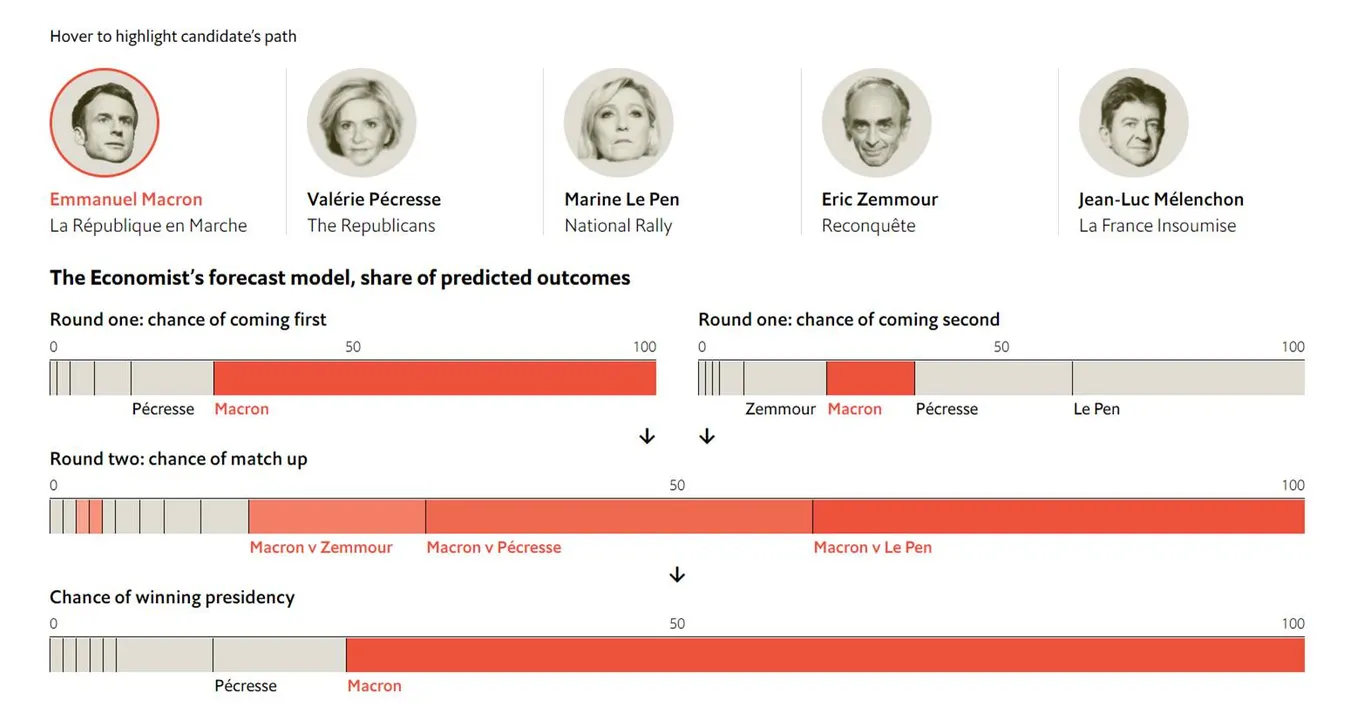
The Economist’s French presidential election model forecasts a 79% chance of victory for Emmanuel Macron; potentially serious challenge from Valérie Pécresse
Read more


Business Finance, Entertainment, Fashion, Government, Health, Lifestyle, Luxury, Non Profit, Innovation, Editorial, Advertising, Circulation, Government, Non Profit, Public Sector, Lifestyle, Entertainment, Fashion, Health
LONDON, UNITED KINGDOM -- March 11th 2021 -- The Economist has developed an interactive covid-19 risk estimator which estimates the probability of risk of hospitalisation or death for an unvaccinated person diagnosed with covid-19 in America within 30 days of a positive test for covid-19. The model does not have enough information to deliver accurate personalised risk assessments. However, it does provide a helpful starting point for people seeking such information, by estimating group averages based on age, sex and underlying conditions.
The model is intended to help illuminate how demography and comorbidities interact to make covid-19 so much more deadly in some groups than in others. Additionally, the hope is that this estimator will help people make informed decisions about their risk level as they go about their daily activities.
The estimator was designed in consultation with experts from academia and industry in the United States and answers not whether someone will test positive, but what might happen if they do.
Based on a dataset of more than four billion medical claims filed in America, the estimator allows users to input up to 29 comorbidities such as asthma, diabetes and obesity along with other basic information. The estimator then determines a probability of dying or being hospitalised given age, gender, and underlying conditions from those inputs.
Findings of the covid-19 risk estimator
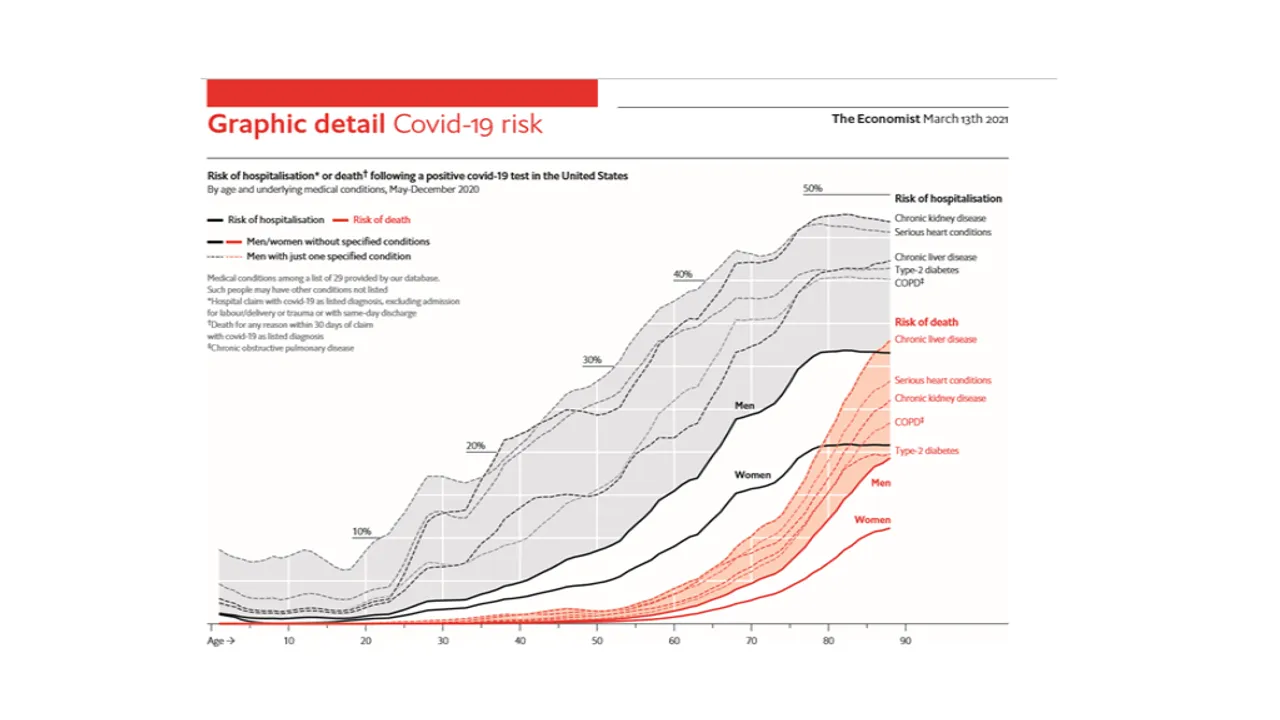
The accompanying Graphic Detail article explains that age is the primary risk factor for death once you have been diagnosed with covid-19. The model considers men in their 70s without any medical conditions more likely to die with covid than men aged 25-34 with underlying conditions.
For example, 9% of men in their 70s without listed comorbidities besides covid-19 died, compared with just 1% for men aged 25-34 with heart disease and hyperlipidemia (high cholesterol).
Blood-related conditions such as heart, liver and kidney problems are larger risk factors than other underlying conditions like respiratory conditions such as asthma and lung disease. You are more likely to be hospitalised or die from covid with a blood-related disease.
Readers should not use this tool as a forward-looking personalised risk assessment. It does not receive enough information about individual patients to provide a customised prognosis, and all of its forecasts are based on an infection occurring in America in early December, 2020--a set of circumstances that will never be repeated.
For more information or to interview our journalists on the covid-19 risk estimator, please contact: US TomAmos@economist.com / UK HollyDonahue@economist.com
About The Economist (Economist.com)
With a growing global audience and a trusted reputation for insightful analysis, The Economist is one of the most widely recognised sources covering current affairs in the world. In addition to the weekly digital and print editions and website, The Economist publishes Espresso, a daily news app, and Global Business Review, a bilingual English-Chinese product. The Economist produces several podcasts each week and short- and long-form video. The Economist maintains robust social communities on Facebook, Twitter, LinkedIn and other social networks. A recipient of many editorial and marketing awards, The Economist was named the most trusted news source by the 2017 Trusting News Project Report.
2 February 2022

2 February 2022

17 November 2021

12 November 2021