2 February 2022
New research reveals business leaders and employees hold differing views on how the pandemic has affected work-life balance and productivity
Read more


Government, Editorial, Public Sector
LONDON, UNITED KINGDOM — February 2nd 2022 — The Economist, one of the world’s most trusted sources of news and analysis, has launched its second statistical forecast of a French presidential election: Economist.com/France2022. The model follows modeling efforts in 2017 which proved more accurate than many popular expert predictions.
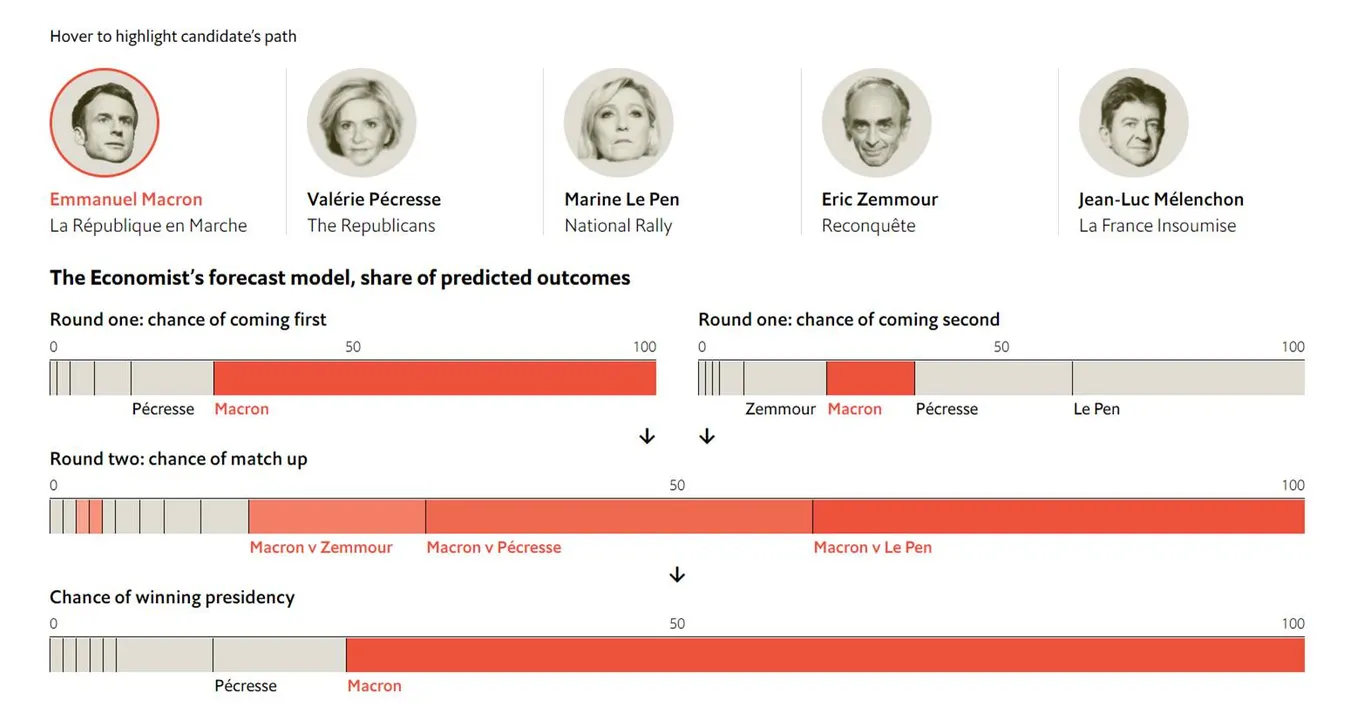
The model indicates that Emmanuel Macron, the current president, is most likely to win the second round of France’s two-stage contest. But his odds depend heavily on who he faces in the second round. Mr Macron currently has a 43% chance of a rematch of his run-off in 2017 against Marine Le Pen; in which case the odds of his victory are 90-in-100. He has a slightly less likely 32% chance of a runoff against Valérie Pécresse, the nominee of the centre-right Republicans. He would have a 76% chance of winning that matchup. As polls currently stand, Mr Macron is almost certain to beat far-right newcomer Éric Zemmour, who launched his own party in December 2021 to run for president.
Yet the model’s large uncertainty intervals mean an upset could happen. The Economist's model gives Mr Macron a 79% chance of winning today. But if the polls this time are out by a higher-than-average margin Mrs Pécresse could still win the presidency. Worry that polls are unrepresentative of French voters is particularly high this year, when all polls will be conducted online for the first time. (In past presidential elections, a significant portion of data has been collected over the phone, historically considered a more reliable practice).
Created by The Economist’s data team, the French presidential election model estimates how many votes each candidate will receive in the first round, calculates the probability of each matchup for the second round, and then explores all the outcomes of the election. To produce these figures, the data team trains a series of models on historical polling and presidential election results to calculate the accuracy of polling on each day of historical presidential elections. Our main aim is to capture fully the uncertainty in the election. The model’s projections will be updated daily until polling day for each of the first and second round to reflect the latest available data.
The Economist’s French presidential election model, the first to be published in 2022 by a prominent news organisation, is designed to avoid the flaws that have caused prognosticators to misfire in prior elections, both in France and abroad. The model uses machine-learning methods to ensure forecasts are not overfit to past data, which would make them blind to higher-than-average polling errors in the future, and to hedge against inadvertently calibrating forecasts to the results of past contests.
The Economist’s model pulls in data from France’s major pollsters. The tracker keeps tabs on the runners and riders ahead of two rounds of voting on April 10th and April 24th.
The Economist has a history of producing forecast models for country-level elections, including the French election in 2017, the American mid-terms in 2018, the American presidential and congressional elections in 2020 and the German election in 2021.
The Economist’s French presidential election model can be found here: Economist.com/France2022
More can be read on France’s election here: https://www.economist.com/news/2022/02/02/emmanuel-macron-is-highly-likely-to-be-re-elected-as-frances-president
The Economist has created a hub with all of its French election coverage in the lead up to April, which can be found here: https://www.economist.com/french-election-2022
To interview data journalist G. Elliott Morris or Paris bureau chief Sophie Pedder, please contact:
(France) TheEconomist.France@bcw-global.com
(Rest of world) HollyDonahue@economist.com
About The Economist
With a growing global audience and a reputation for insightful analysis and perspective on every aspect of world events, The Economist is one of the most widely recognised and well-read current-affairs publications in the world. In addition to the weekly print and digital editions and website, The Economist publishes Espresso, a daily news app, and Global Business Review, a bilingual English-Chinese product. It produces The Intelligence, a daily current-affairs podcast, several other weekly podcasts and short- and long-form video. The Economist maintains robust social communities on Facebook, Twitter, LinkedIn and other social networks.
2 February 2022

17 November 2021
12 November 2021
8 November 2021