2 February 2022
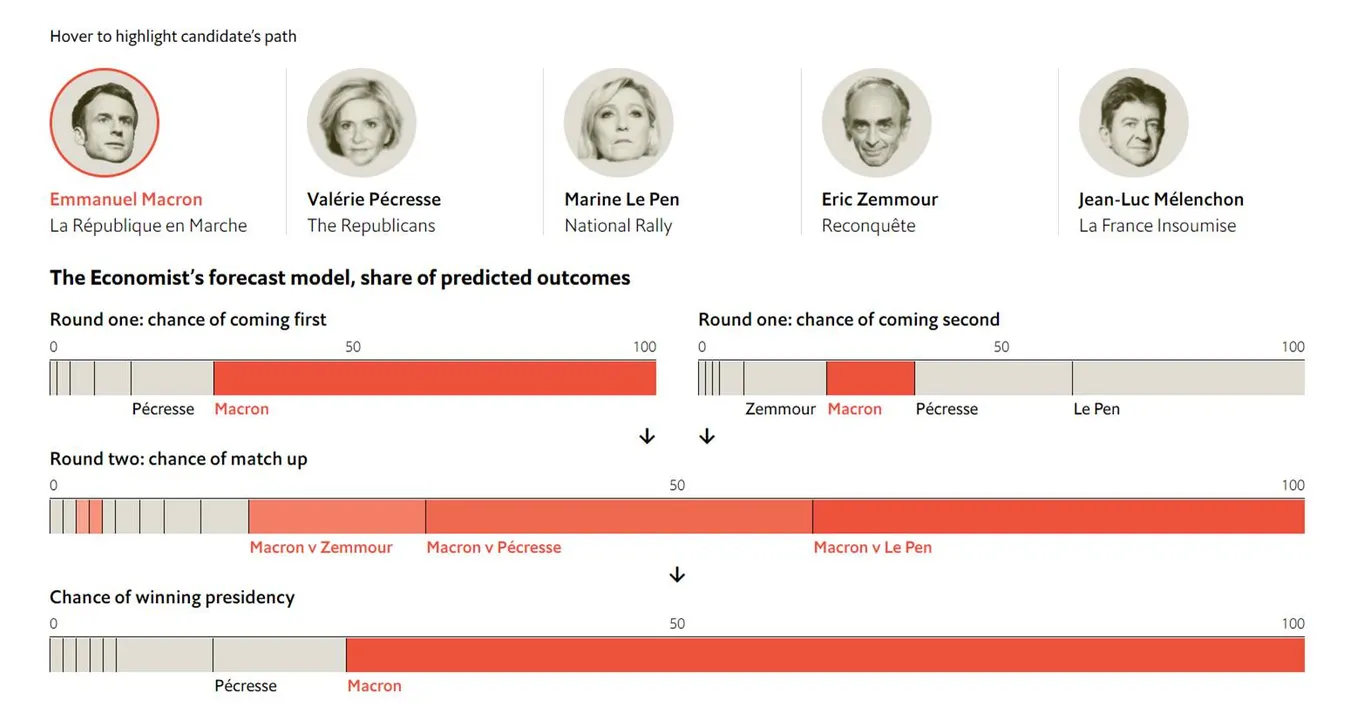
The Economist’s French presidential election model forecasts a 79% chance of victory for Emmanuel Macron; potentially serious challenge from Valérie Pécresse
Read more



Health
Coinciding with National Nutrition Month, 1843, luxury lifestyle magazine from The Economist, is marking it's launch with a redesign of the magazine and a cover article lifting the lid on the world’s most misleading measure.
Titled ‘Death of the Calorie’ the article recognises how doctors and governments are quick to recommend eating less and moving more to lose weight, usually by counting calories. The World Health Organisation (WHO) attributes the “fundamental cause” of obesity worldwide to “an energy imbalance between calories consumed and calories expanded”.
The cover article makes the case for ‘burying the world’s most useless measure’ explaining how counting calories is very crude and often misleading. Most studies show that more than 80% of people regain any lost weight in the long term. In her maiden feature article as editor-in-chief of 1843, Rosie Blau brings to the fore up to date studies that conclude “tallying calories will do little help us control our weight or even maintain a healthy diet: the beguiling simplicity of counting calories in and calories out is dangerously flawed!”
The article highlights important aspects that are overlooked which include:
The word (from the Latin ‘calor’) and principle of determining calories originated from measuring the efficiency of steam engines: one calorie the energy required to heat 1kg of water by one dress Celsius
Wilbur Atwater popularised the idea calories could be used to measure both the energy contained in food and the energy the body expended on things like muscular work, tissue repair and powering the organs. The studies he conducted a century ago, without calculators or computers, have never been repeated even though our understanding of how our bodies work is vastly improved
By Atwater’s measure, dishes low in calories, but rich in sugar and carbohydrates, seemed far healthier
Calorie counts are based on how much heat a foodstuff gives off when it burns in an oven, but the human body is far more complex than an oven.
Two items of food with identical caloric values may be digested in very different ways
The time of day food is eaten has an impact on digestion
The amount of energy we absorb from food depends on how we prepare it
A senior adviser to the UN’s Food and Agriculture Organisation warned in 2002 that the Atwater “factors” if a 4-4-9 at the heart of the calorie counting system were a “gross over simplification” and so inaccurate. The organisation said it would give “further consideration” to overhauling the system, but 17 years later there is little momentum for change.
About 1843
March 13th 2019, The Economist announces the relaunch of its bi-monthly lifestyle publication 1843, named for the year The Economist was founded. 1843 gives readers stories of an extraordinary world, long-form narrative journalism, irreverent columnists and some of the world’s best photography and illustration. It brings the wit and rigour of The Economist to the world of design, style, food and travel. 1843 is on sale March 13 in the UK and March 19 in the US on newsstands, at www.1843magazine.com and on The Economist Classic app.
“1843 takes a sideways look at the enduring stories of our age, and seasons them with a dash of humour or irreverence. Our perspective is provocative, rigorous, independent and entertaining -- qualities that are reflected in the magazine’s sophisticated style and beautiful design,” said Blau. “Bringing together talent from around the globe, 1843 tells the stories of the individuals and forces that shape our lives. Our aim is to make you see the world in a new way.”
FOR MORE INFORMATION PLEASE CONTACT:
emilee.senchyna@tvcgroup.com - 0207 380 8000 | 07535 4808
2 February 2022
2 February 2022

17 November 2021

12 November 2021