2 February 2022
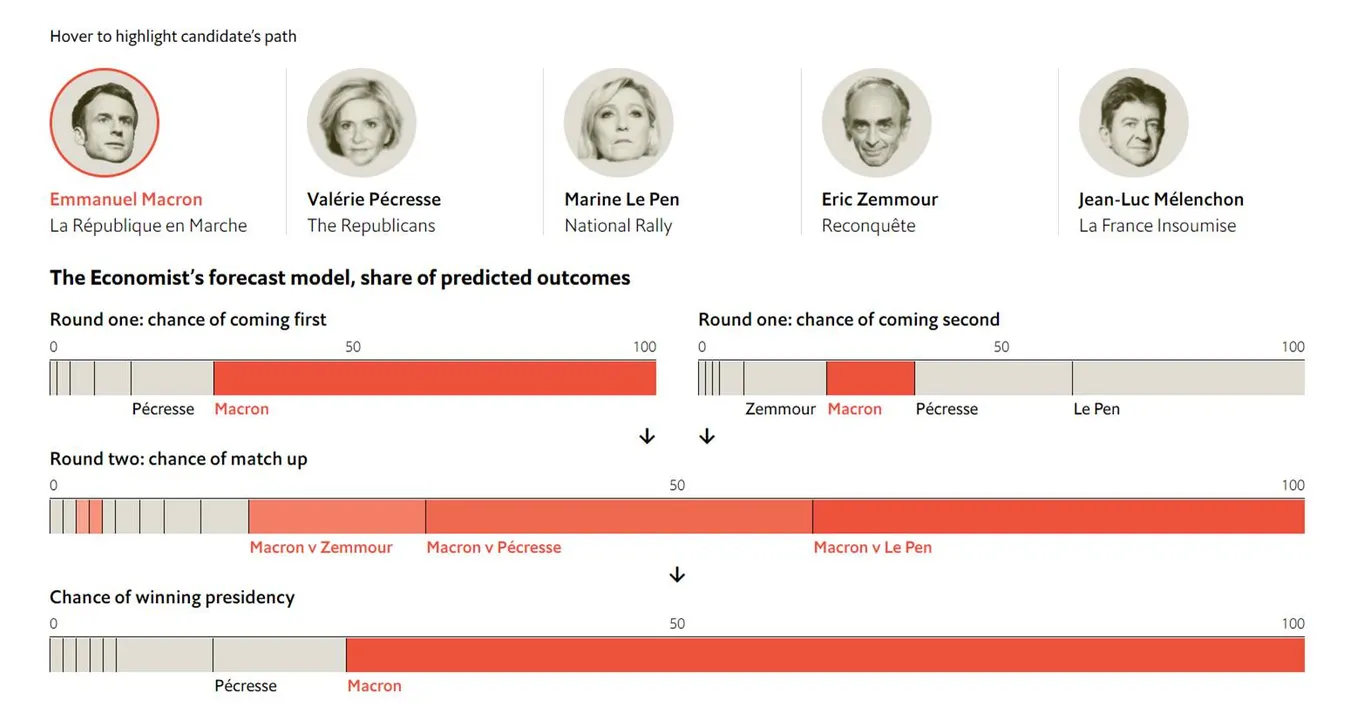
The Economist’s French presidential election model forecasts a 79% chance of victory for Emmanuel Macron; potentially serious challenge from Valérie Pécresse
Read more


Business Finance, Government, Technology, Editorial, Business Finance, Government, Technology
Technology and politics: The signal and the noise
Ever easier communications and ever growing data mountains are transforming politics. What will that do to democracy?
Highlights:
The internet is making political mobilisation much easier. Like-minded people can find each other faster without the need for a formal organisation. This has helped protest movements the world over take off It is also making politics more visible: Since any kind of collective action now has some online element, it leaves a digital footprint that can be analysed with ever more sophisticated analytics software. That changes the balance of power. Autocratic governments can now monitor protests in their countries and intervene if they feel it is necessary Social media such as Twitter and Facebook and other online data are making politics more targeted. Campaign organisations now find it much easier to identify supporters and communicate their messages to them At the local level, the ability to analyse large quantities of data makes it easier to improve, for example, services in cities and involve residents more closely in decision-making(London) -- This week The Economist publishes a special report on technology and politics, written by Ludwig Siegele, the paper’s technology editor. The report argues that the internet has become indispensable to the conduct of politics, both because of the ease of communication it brings and because of the piles of data it generates. In itself it is neither good nor bad, but it undoubtedly has an effect and acts as an intensifier of whatever trends are in the wind. Political campaigns such as that for America’s presidential election now rely heavily on it. Some of the protest movements of recent years--the Arab spring, the Occupy movement, the BlackLivesMatter campaign--would have been unthinkable without it.
When it first took off, the internet was seen as a democratising force, giving ordinary people both more knowledge and more power to engage in politics. On balance, the world is still a more democratic place than in pre-internet days, but there is growing concern that it is governments and other big organisations that have the best access to data and the most resources to analyse them, and are therefore best able to use the internet for their purposes. To avoid misuse, the report argues, much more transparency about its deployment in politics is needed.
-ENDS-
Media notes
For details on this press release or to arrange an interview with technology editor Ludwig Siegele, please contact hollydonahue@economist.com
About The Economist (www.economist.com) With a growing global circulation and a reputation for insightful analysis and perspective on every aspect of world events, The Economist is one of the most widely recognised and well-read current affairs publications. The paper covers politics, business, science and technology, and books and arts, concluding each week with the obituary. In addition to the web-only content such as blogs, debates and audio/video programmes available on the website, The Economist is available to download for reading on Android, Blackberry PlayBook, iPhone or iPad devices. The Economist Espresso, our daily briefing smartphone app, is also available for download via iTunes App Store or Google Play.
2 February 2022
2 February 2022
17 November 2021
12 November 2021