2 February 2022
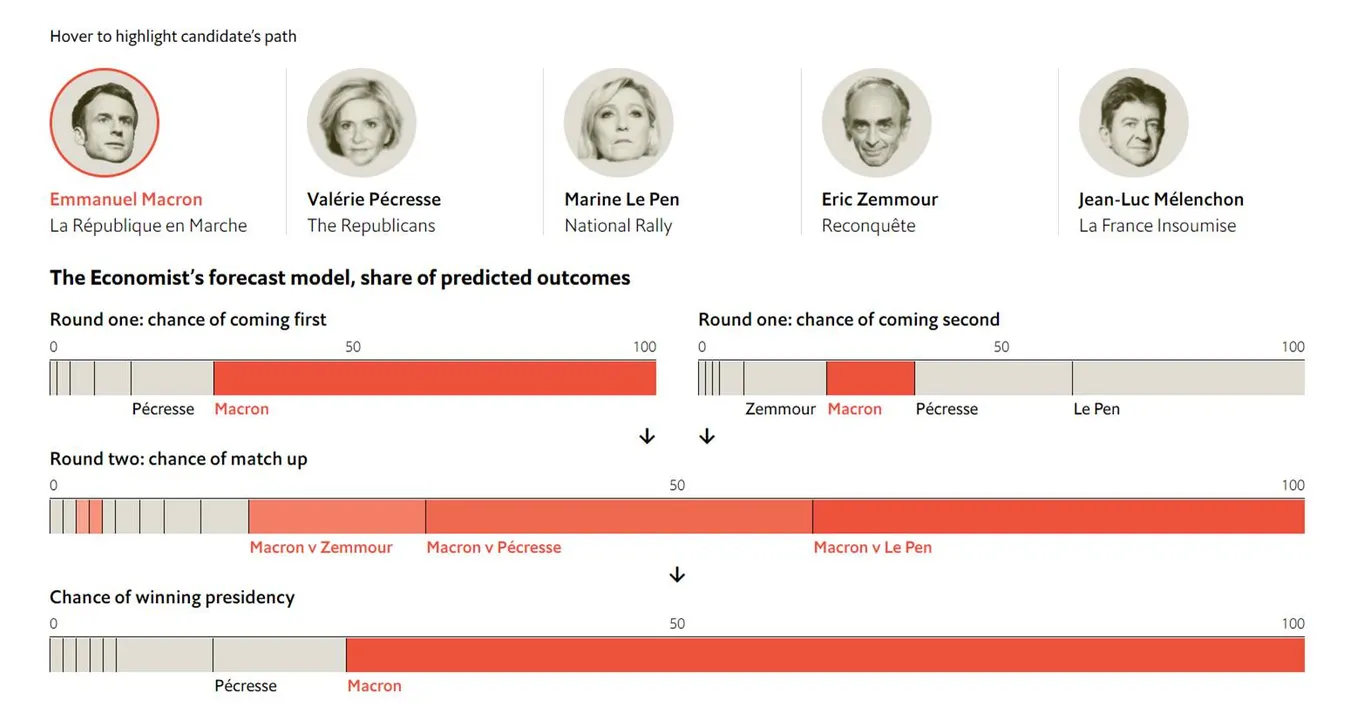
The Economist’s French presidential election model forecasts a 79% chance of victory for Emmanuel Macron; potentially serious challenge from Valérie Pécresse
Read more


Government
LONDON, UNITED KINGDOM — August 11th 2021 — The Economist, one of the world’s most trusted sources of news and analysis, has launched its first-ever statistical forecast of a German election https://econ.st/3jKNbbX
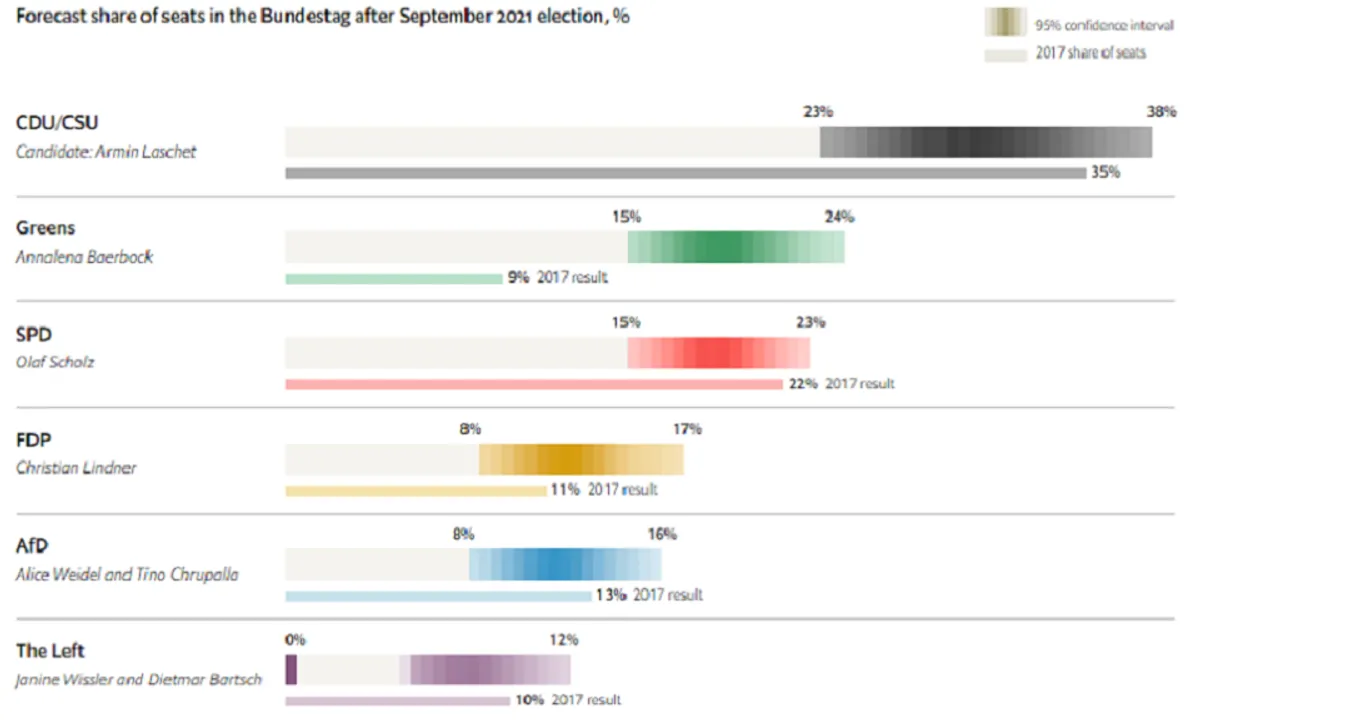
The model indicates that on current polling, three plausible coalitions have an even chance, or better, of mustering enough seats to form a majority after the election on September 26th. These include:
Yet the model’s large uncertainty intervals mean the election remains wide open. The Economist's model gives a 95% chance of the CDU/CSU winning between 24% and 38% of the vote, for instance.
Created by The Economist’s data team, the German election model estimates how many seats each party will win in the Bundestag, Germany’s lower house of parliament. To produce these figures, the data team trains a series of models on historical polling and election results to identify the combination of each indicator that generates the optimal forecasts of prior election results. Special attention is paid to the accuracy of past polling to fully capture the uncertainty in the forecast. The model’s projections will be updated daily until the election to reflect the latest available data.
The Economist’s German election model, the first to be published in 2021 by a prominent news organisation, aims to avoid the flaws that have caused prognosticators to misfire in prior elections, both in Germany and abroad. The model uses machine-learning methods to ensure forecasts are not overfit to past data, which would make them blind to higher-than-average polling errors in the future, and to hedge against the polls with other information.
The data fed into The Economist’s German election model come in part from The Economist’s recently published poll-tracker. Updated daily, it pulls in data from Germany’s main pollsters. The tracker keeps tabs on the runners and riders ahead of September's contest. The Economist’s model converts parties' vote-share forecast into an estimate of seats won, from which we derive seat counts for the potential coalitions that could govern Europe’s biggest economy.
G. Elliott Morris, data journalist at The Economist, said: “The polls have really gotten a bad rap lately. Backlash has tended to be overblown, but some skepticism is warranted. Yet people are still consuming the polls for Germany’s upcoming election without the proper caution. We wanted to design and present a polling model that fully captured the uncertainty in the election and improved how readers digest these data.”
Mr Morris continued, “Contrary to popular expectations, past polls of the Bundestagswahl have been even less accurate in Germany than in the US; forecasts are off by two or three points in a normal election, and five or six in bad years. So our goal is not only to provide accurate forecasts for each party’s vote share, but also to explain the uncertainty in the race so none of our readers are shocked by the outcome (unless the statistics warrant it).”
Tom Nuttall, The Economist’s Berlin bureau chief, said: "Germany is facing a pivotal election in September as Angela Merkel prepares to step down after nearly 16 years as chancellor. The next government will set the agenda for Europe's largest economy and play a crucial role in the EU's future. We hope The Economist's election model will give Germans and international observers a more sophisticated understanding of the opinion polls in the run-up to what remains an unusually open election."
The methodology for The Economist’s German election model is open-source and available to anyone here: https://econ.st/3CAgG8S
The Economist has created a hub with all of its German election coverage in the lead up to September 26th, which can be found here: https://www.economist.com/german-election-2021
To interview data journalist G. Elliott Morris, Berlin bureau chief Tom Nuttall or European business correspondent Vendeline von Bredow, please contact: HollyDonahue@economist.com or +44 (0)7715621079
About The Economist
With a growing global audience and a reputation for insightful analysis and perspective on every aspect of world events, The Economist is one of the most widely recognised and well-read current-affairs publications in the world. In addition to the weekly print and digital editions and website, The Economist publishes Espresso, a daily news app, and Global Business Review, a bilingual English-Chinese product. It produces The Intelligence, a daily current-affairs podcast, several other weekly podcasts and short- and long-form video. The Economist maintains robust social communities on Facebook, Twitter, LinkedIn and other social networks.
2 February 2022

2 February 2022

17 November 2021

12 November 2021