2 February 2022
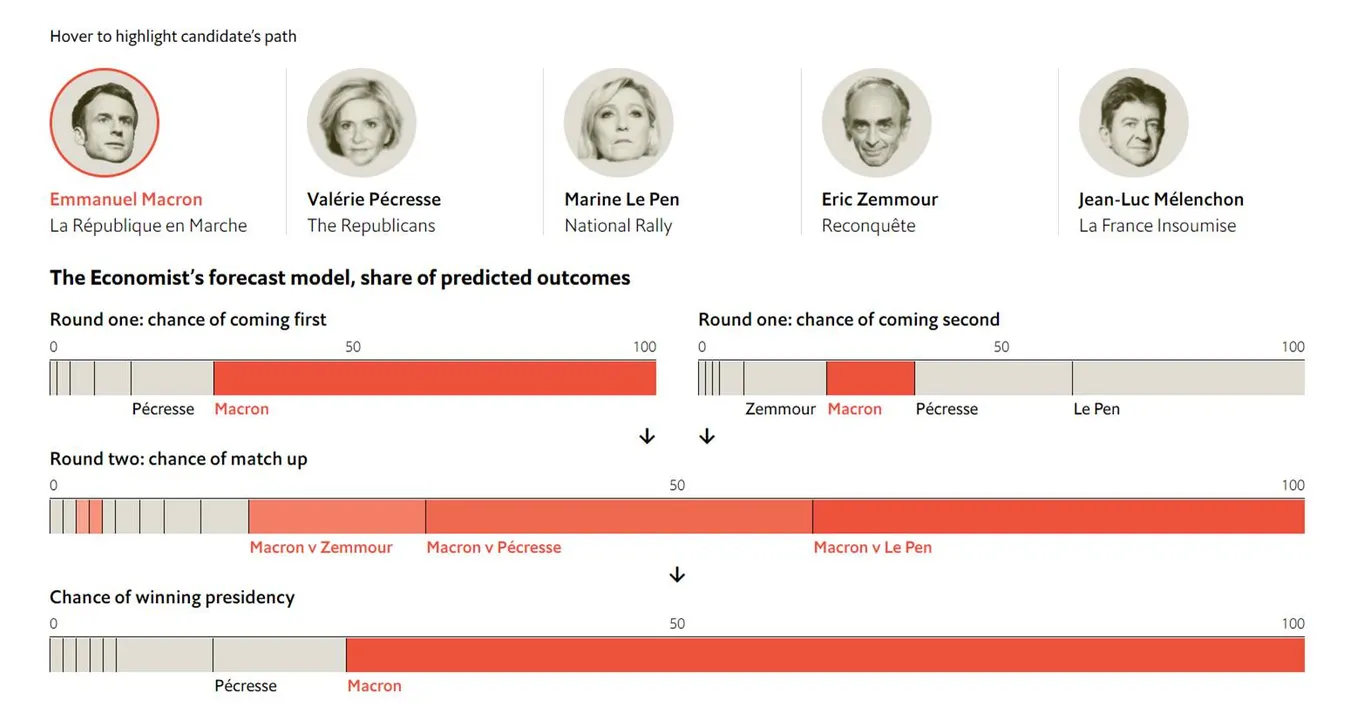
The Economist’s French presidential election model forecasts a 79% chance of victory for Emmanuel Macron; potentially serious challenge from Valérie Pécresse
Read more


Government, Health
LONDON, UNITED KINGDOM - August 18, 2020 - Bill Gates, co-founder of Microsoft and co-chair of the Bill & Melinda Gates Foundation, sat down for a filmed virtual interview with Zanny Minton Beddoes, The Economist’s editor-in-chief, to discuss the world’s response to the covid-19 crisis. The conversation is the latest installment of “Inside Story,” a series of digital events for subscribers to The Economist.
In an extended interview, Mr Gates discussed three topics at length: the US response to the pandemic, the amount of global spending required for a vaccine and the development timeline, and finally, his assessment of the global scale of the impact of the coronavirus including the challenges faced collecting data from developing countries around the world under dynamic conditions.
US response to the pandemic
Mr Gates said the US failed before the coronavirus came along by not getting ready. “We didn’t run simulations to realise getting testing up quickly would be important.” And once it hit, more mistakes were made. Overall, he says “the response was less good than I would have expected.”
Gates also said in the US “we believe in freedom, individual freedom. We optimise for individual rights.” The ethos of individualism, combined with bad luck regarding the CDC’s slow and complicated test that didn’t work, were part of the failure. In addition to those factors, the US “didn’t let commercial labs come in” unlike South Korea and other countries calling up labs “to go full speed.” Gates also added, “I don’t think a change in administrations will get people to wear masks...it’s hard to see how we build that trust network and improved behaviour. It’ll mostly be incremental.”
Vaccine spending & timeline
Gates outlined six efforts from various pharmaceutical labs that will all be in phase three by the end of September adding that “we all need to spend billions to get the vaccine out to save the trillions that the economic damage is doing.”
Aside from the US, many countries funding R&D need to think about their co-ordination and he praised the US “thank goodness...with all its imperfections, was there to move things ahead.” But we need to ask why other countries “weren't able to orchestrate early high-risk money...they did some things, but it was far short.” Ultimately, the vaccine effort has to be a collective global effort and not a selfish one.
Many of the vaccines are low-cost. When distributed, the cost of the vaccine will be higher in middle and rich countries. In the poorer countries “ten or twelve billion [dollars] total to buy the vaccine for the developing world would almost certainly suffice. And that's a tiny number that the Europeans have tried to raise. But without the US taking its leadership role as it's done on most global health things, it's been hard to get that together.”
Gates thinks by the end of the year factories will be organised and phase three trials could be complete.
With respect to rollout of doses, Gates posits: ”you could imagine that by late 2021, you would have enough doses that you're almost done. But with just a little bit of spill over into 2022...I think by...2021, it will bring the pandemic to an end.”
Scale of the harm in the emerging world
According to Gates, “the worst is still ahead” in the developing world and that “these are not countries that can just issue debt like mad without feeling inflationary pressures through the exchange rate. And so they live in the economic world where money is not free.”
In the emerging world, the “citizens of these countries are just left on their own with way less of a health-care system.” And “sadly, like every bad event...the poorest in the US suffered more than the wealthy and the poor countries suffered way, way more than the rich countries, particularly the poorest in the poor countries.”
Regarding the scale of damage Gates said: “these statistics will be millions of deaths, you know...Most people have a hard time relating to that figure..we have to come up with a way to make it visceral for people...And there's a tendency to care less about people far away when you've got budgets and other challenges at home.”
Gates wondered “will Europe stay as generous as they've been on these things? And will the US, which had a tradition of supporting global health initiatives, will it stay engaged in the game once the pandemic is over or will this turning inwards mean that there's even less help to get these guys out of this deep hole they'll find themselves in?”
He closed on a positive note. If people reflect upon the lessons learned from the pandemic, those lessons can be applied to climate change. “I'm hopeful that reminds people that, yes, you have to prepare in advance. Climate change isn't uncertain… innovation continues, whether it's on global health tools or likewise on climate. The reason I think we can solve it is we get behind the innovation, both the supply of innovation, the demand for innovation, the policies that encourage that innovation.”
The Economist subscriber-only digital events
This “Inside Story” interview is part of a recently launched series of live digital events exclusively for subscribers to The Economist. The discussions are designed to give the inside story on the events shaping the world and to draw back the curtain on how The Economist works. Previous episodes have included a view into the weekly editorial process and an in-depth discussion of the economics and science of covid-19. Upcoming webinars include a discussion with The Economist’s political cartoonist, Kal, and a series leading up to the American presidential election in November, led by the hosts of our “Checks and Balance” podcast on American politics.
For more information, including video clips and excerpts from the transcript, please contact: tomamos@economist.com in the US or hollydonahue@economist.com in the UK.
PLEASE CREDIT: THE ECONOMIST
About The Economist
With a growing global audience and a reputation for insightful analysis and perspective on every aspect of world events, The Economist is one of the most widely recognised and well-read current affairs publications in the world. In addition to the weekly print and digital editions and website, The Economist publishes Espresso, a daily news app, Global Business Review, a bilingual English-Chinese product and Economist VR, a virtual-reality app. Economist Radio produces several podcasts a week and Economist Films produces short- and long-form video. The Economist maintains robust social communities on Facebook, Twitter, LinkedIn, Medium and other social networks. A recipient of many editorial and marketing awards, The Economist was named the most trusted news source by the 2017 Trusting News Project Report.
2 February 2022
2 February 2022
17 November 2021
12 November 2021