2 February 2022
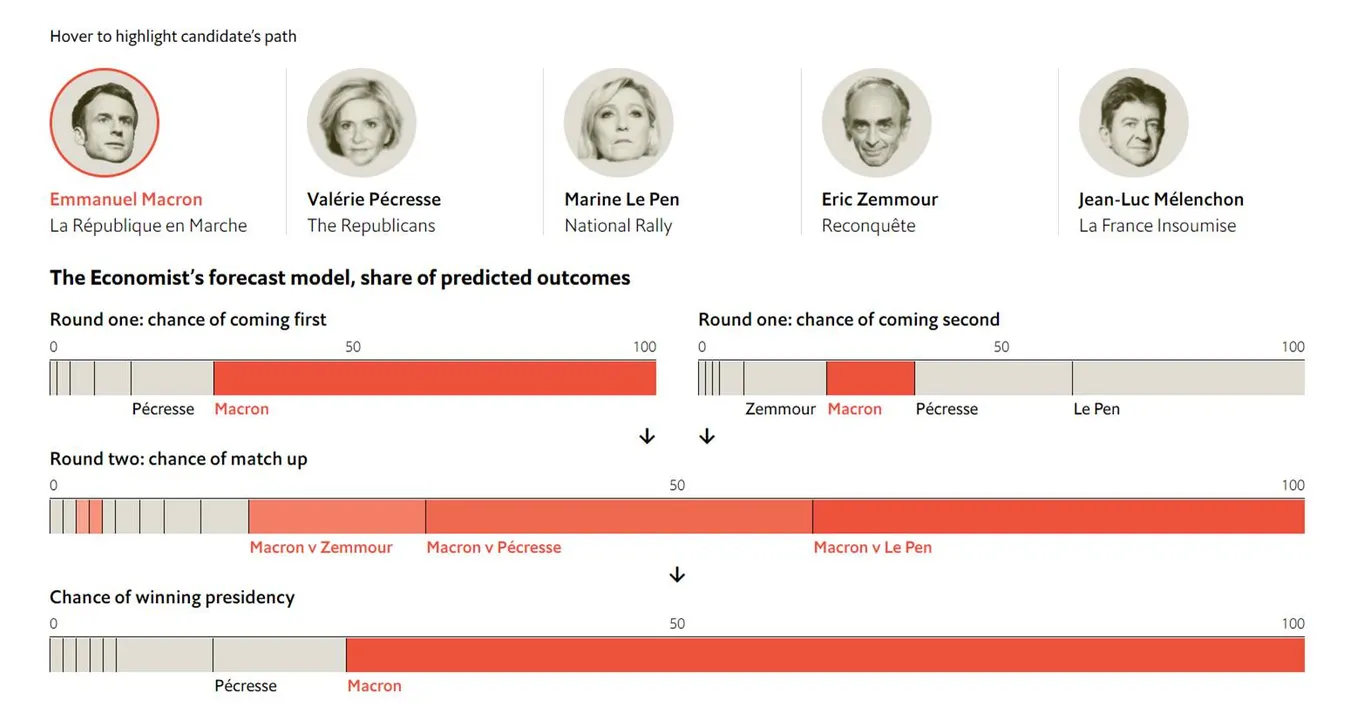
The Economist’s French presidential election model forecasts a 79% chance of victory for Emmanuel Macron; potentially serious challenge from Valérie Pécresse
Read more



Business Finance, Consumer, Government
LONDON, UNITED KINGDOM - December 5, 2019 - The Economist has published its endorsement of the Liberal Democrats in the UK’s general election https://econ.st/366JVyZ
According to The Economist, Jeremy Corbyn’s Labour Party is attempting to deal with 21st-century problems using hard-left policies that failed in the 20th. It has become much more extreme since the last election:
“In 2017 Labour was on the left of the European mainstream. Today it would seize 10% of large firms’ equity, to be held in funds paying out mostly to the exchequer rather than to the workers who are meant to be the beneficiaries. It would phase in a four-day week, supposedly with no loss of pay. The list of industries to be nationalised seems only to grow. Drug patents could be forcibly licensed. The bill for a rapid increase in spending would fall on the rich and companies, whose tax burden would go from the lowest in the G7 to the highest.”
This combined with Mr Corbyn’s distorted worldview and his failure to deal with anti-Semitism in his party, rules Labour out, according to The Economist. Although some Remainers might swallow these problems as the price of a second referendum, which Corbyn has promised, The Economist concludes that “Mr Corbyn’s ruinous plans at home and bankrupt views abroad mean that this liberal newspaper cannot support Labour.”
It argues that the Conservatives under Boris Johnson have also become a party of extremes since 2017, particularly with regards to Brexit:
“Mr Johnson has ditched the Brexit deal negotiated by Theresa May and struck a worse one, in effect lopping off Northern Ireland so that Britain can leave the European Union’s customs union. The public are so sick of the whole fiasco that his promise to ‘get Brexit done’ wins votes. But he would do no such thing. After Britain had left the EU early next year, the hard work of negotiating a trade agreement would begin. Mr Johnson says he would do this by the end of 2020 or leave without one. No-deal is thus still on the table—and a real prospect, since getting a deal in less than a year looks hard.”
The Economist states that the problems with Boris Johnson go beyond Brexit. “He has purged moderates and accelerated the shift from an economically and socially liberal party into an economically interventionist and culturally conservative one.” His repeated lies have corroded the public’s trust in democracy.
That leaves the Liberal Democrats, according to The Economist, who, despite their “irresponsible promise to reverse Brexit unilaterally”, have the best economic approach: “a moderate increase in spending, paid for by broad-based tax increases...the only one to be honest about the cost of an ageing society.” The leader goes on to state that “they are the only choice for anyone who rejects both the hard Brexit of the Conservatives and the hard-left plans of Labour.”
Though The Economist acknowledges the Liberal Democrats have little chance of winning the election, it argues that a vote for them would restrain whoever ends up in Downing Street: “There is no good outcome to this nightmare of an election. But for the centre to hold is the best hope for Britain.”
The full endorsement and related Britain stories will appear in the December 7th print edition of The Economist and online at https://econ.st/366JVyZ
The Economist’s UK general election 2019 hub can be found here: economist.com/ukelection2019
The Economist conducted polling in five key constituencies ahead of the election. Read about the results for Gedling, Reading West, Grimsby, Warwick and Wrexham
To find out more or to arrange an interview, please contact: HollyDonahue@economist.com or +44 (0)7715621079.
About The Economist
With a growing global audience and a reputation for insightful analysis and perspective on every aspect of world events, The Economist is one of the most widely recognised and well-read current affairs publications in the world. In addition to the weekly print and digital editions and website, The Economist publishes Espresso, a daily news app, Global Business Review, a bilingual English-Chinese product and Economist VR, a virtual-reality app. Economist Radio produces several podcasts a week and Economist Films produces short- and long-form video. The Economist maintains robust social communities on Facebook, Twitter, LinkedIn, Medium and other social networks. A recipient of many editorial and marketing awards, The Economist was named the most trusted news source by the 2017 Trusting News Project Report.
2 February 2022
2 February 2022

17 November 2021
12 November 2021